

301 Southlake Blvd #101
North Chesterfield, VA 23236
Knee Pain Chiropractor in North Chesterfield VA
Knee Pain North Chesterfield
Home >> Conditions >> Knee Pain

Here is something worth knowing about knee pain before you spend more time treating the wrong thing. The knee is a hinge joint caught between the hip and the ankle, and when either of those joints is not moving or loading correctly, the knee absorbs the compensation. That is why so many people come to see a knee pain chiropractor in North Chesterfield at The ChiroSolution after months of treatments focused only on the knee that never quite worked.
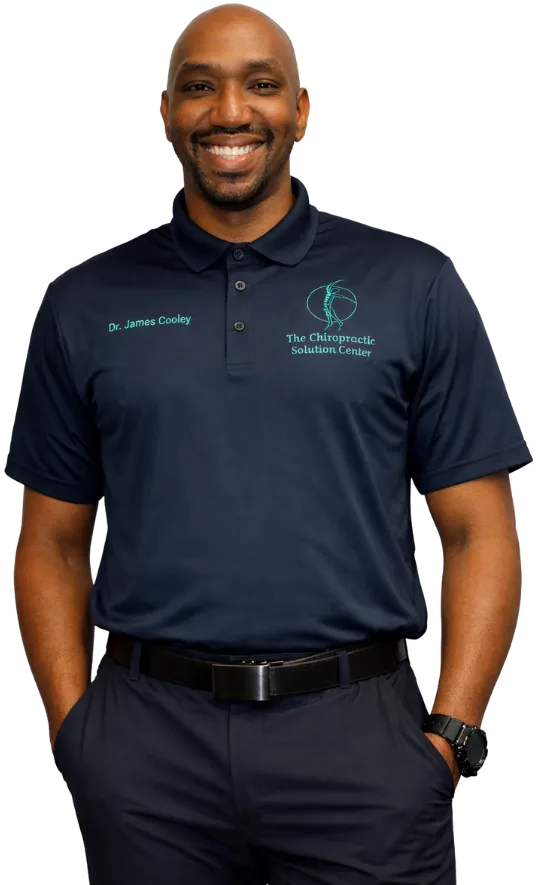
Dr. Cooley looks at the whole picture because that is where the real cause almost always lives. The knee is usually the victim, not the culprit, and until the hip mechanics, ankle mobility, and foot loading patterns are properly evaluated and addressed, the pain tends to keep coming back no matter how much you rest it.
Why your knee keeps hurting even after you rest it
Rest helps the acute inflammation calm down. But if the movement pattern driving the problem has not changed, the pain comes back as soon as you return to activity. That is the cycle most people with recurring knee pain are stuck in. The knee gets irritated, they rest, it settles, they do the same things, it flares again.
The most common culprits found upstream of knee pain are hip weakness and poor hip mechanics that cause the knee to collapse inward under load, restricted ankle dorsiflexion from tight calves that forces the knee to compensate during movement, and foot pronation patterns that alter the entire lower extremity alignment.
Patellofemoral syndrome, IT band syndrome, and medial knee pain are common diagnoses, but they are almost always the result of these upstream patterns rather than purely local problems. Patients dealing with back pain or hip pain alongside their knee symptoms are often surprised to learn how directly connected those issues are.
What Patients Commonly Experience
Knee pain presents differently from person to person. These are the symptoms we hear most often at The ChiroSolution:
● Pain that spikes going up or down stairs or inclines
● Swelling or fullness around the knee following exercise or a long day on your feet
● Stiffness and achiness when standing up after sitting for a while
● Pain on the outer side of the knee, often from IT band tension
● A sense that the knee buckles or feels unstable under load
● Clicking or grinding sensations inside the knee during movement
How Dr. Cooley Evaluates and Treats Knee Pain
A proper knee evaluation starts above and below the knee, not just at it. Dr. Cooley looks at how the hip moves, how the ankle moves, how the foot loads, and how all of that connects to what is happening at the knee joint. Our INSiGHT scans pick up nervous system stress patterns in the lumbar and sacral region even when the primary complaint is knee pain, because the nerve supply to the lower extremity originates there. Patients who have also been dealing with sciatica or plantar fasciitis often find that addressing the full chain produces improvements in multiple areas at once.
Treatment involves extremity adjustments to the knee, hip, ankle, and foot joints as needed to restore proper mechanics throughout the chain, along with lumbar and sacral adjustments when the nerve supply picture calls for it. Soft tissue work on the quadriceps, IT band, hamstrings, calf, and hip flexors reduces the muscle tension that is altering joint tracking and keeping the knee under abnormal load.
What You Can Expect to Get Back
Most patients with knee pain want to walk comfortably, climb stairs without dreading it, return to exercise, or simply get through a workday without the knee becoming a constant distraction. Those are reasonable goals, and most people Dr. Cooley treats with knee pain get there when the underlying biomechanical pattern is properly addressed.
After your scans and exam, you will get a realistic picture of what your care will look like and how long it is likely to take. If imaging or a different specialist is needed alongside the care, Dr. Cooley will tell you that directly. Call The ChiroSolution at (804) 601-1730 to schedule your evaluation.
Begin your healing journey!
Time to join friends going out! If your body pain has long been limiting you, you’ve got to make it end. Whether it’s whiplash, sciatica, headache, low back pain, or accident-caused dysfunctions, let’s talk it out. Book an appointment with us and, together, let’s make that relief possible.

At The ChiroSolution, we offer gentle, neurologically-focused chiropractic care that helps you move and feel better again.


Quick links
Office Hours
Mon, Wed | 3 PM – 6 PM
Tue, Thu | 10 AM – 6 PM
Fri | 10 AM – 1 PM
Sat - Sun | Closed
Get in Touch
301 Southlake Blvd #101
North Chesterfield, VA 23236
Copyright © 2026 The ChiroSolution